
| Field | Transportation Engineering |
| Managing unit | Department of Transportation Engineering, Faculty of Civil Engineering |
| Institution | Thuyloi University |
UNDERGRADUATE PROGRAMME
Introduction
The undergraduate programme prepares engineers to plan, survey, design, construct, test, operate and maintain transportation infrastructure. It combines engineering fundamentals with specialised study in bridges, highways, tunnels and railway systems, supported by design projects, field experience and a capstone thesis.
Highlights
Learning is organised around authentic infrastructure problems and the use of contemporary design, analysis and digital tools. Sustainability, environmental assessment, safety, risk management and interdisciplinary coordination are integrated across the curriculum.
| Credits | 155 credits, excluding Physical Education and National Defence Education |
| Duration | 4.5 years (9 semesters) |
| Mode | Full-time |
| Degree | Engineer in Transportation Engineering |
Objectives
Graduates are expected to apply advanced engineering knowledge to complex transportation problems; use appropriate computational and digital tools; communicate and collaborate effectively; act with professional responsibility; and adapt through innovation and lifelong learning.
Career Prospects
Graduates may work in government transport agencies, project management units, design and supervision consultancies, contractors, infrastructure operators, research institutes and higher-education institutions. Roles include design engineer, site engineer, project coordinator, inspection or maintenance engineer, technical consultant and infrastructure manager.
Major 1 — Bridge, Highway and Tunnel Engineering
This major integrates highway and airport infrastructure, bridge systems and underground works. Students develop competence in route and geometric design, structural analysis, foundation and pavement engineering, bridge and tunnel design, construction methods, maintenance and project evaluation.
Major 2 — High-Speed and Urban Railway Engineering
This major focuses on railway alignment, subgrade and track systems, bridges, tunnels and underground stations, together with operations, safety, BIM, structural monitoring and system integration for high-speed and urban rail networks.
Curriculum Structure
| Knowledge block | Credits | Share |
| General education | 43 | 27.7% |
| Engineering fundamentals | 31 | 20.0% |
| Core-area fundamentals | 18 | 11.6% |
| Major core requirements | 36 | 23.2% |
| Major electives | 12 | 7.7% |
| Internship and capstone thesis | 15 | 9.7% |
| Total | 155 | 100% |
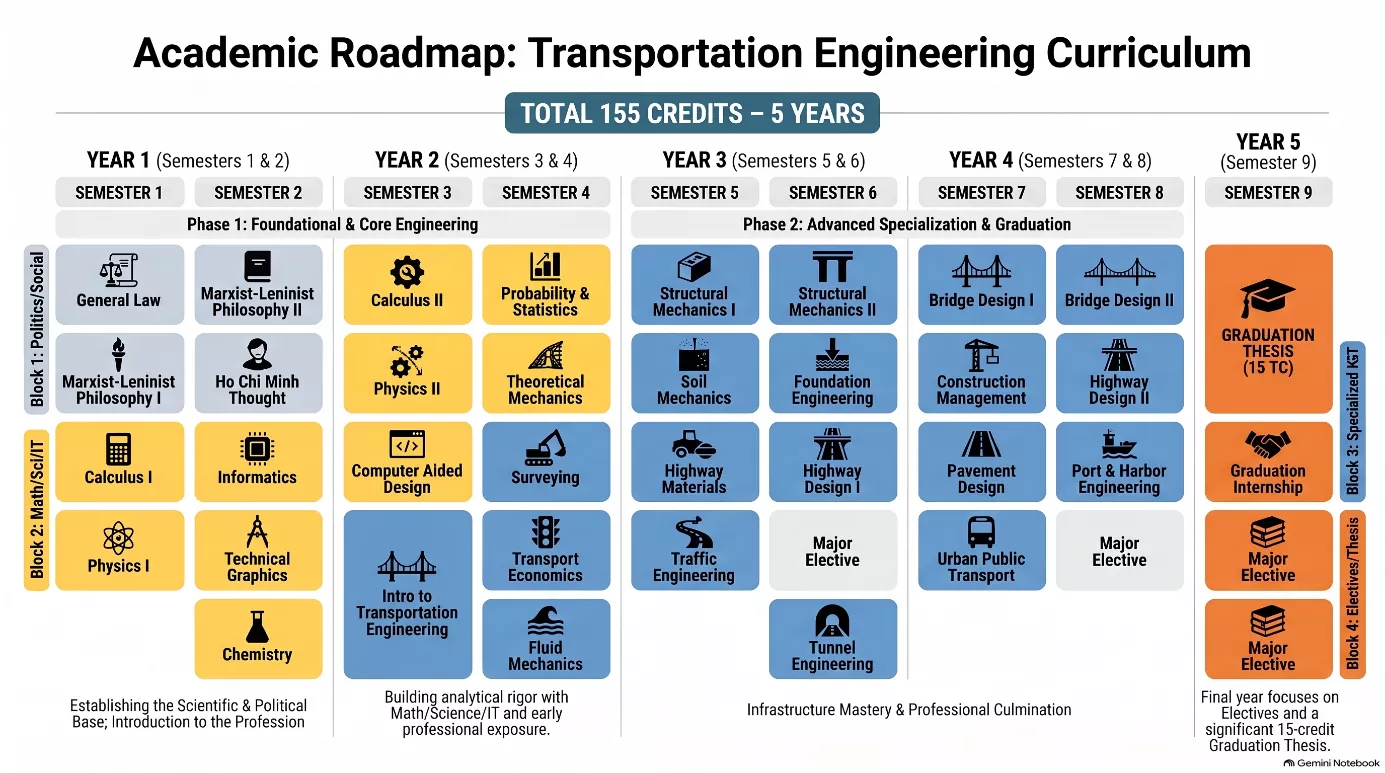
Academic roadmap supplied for Transportation Engineering.
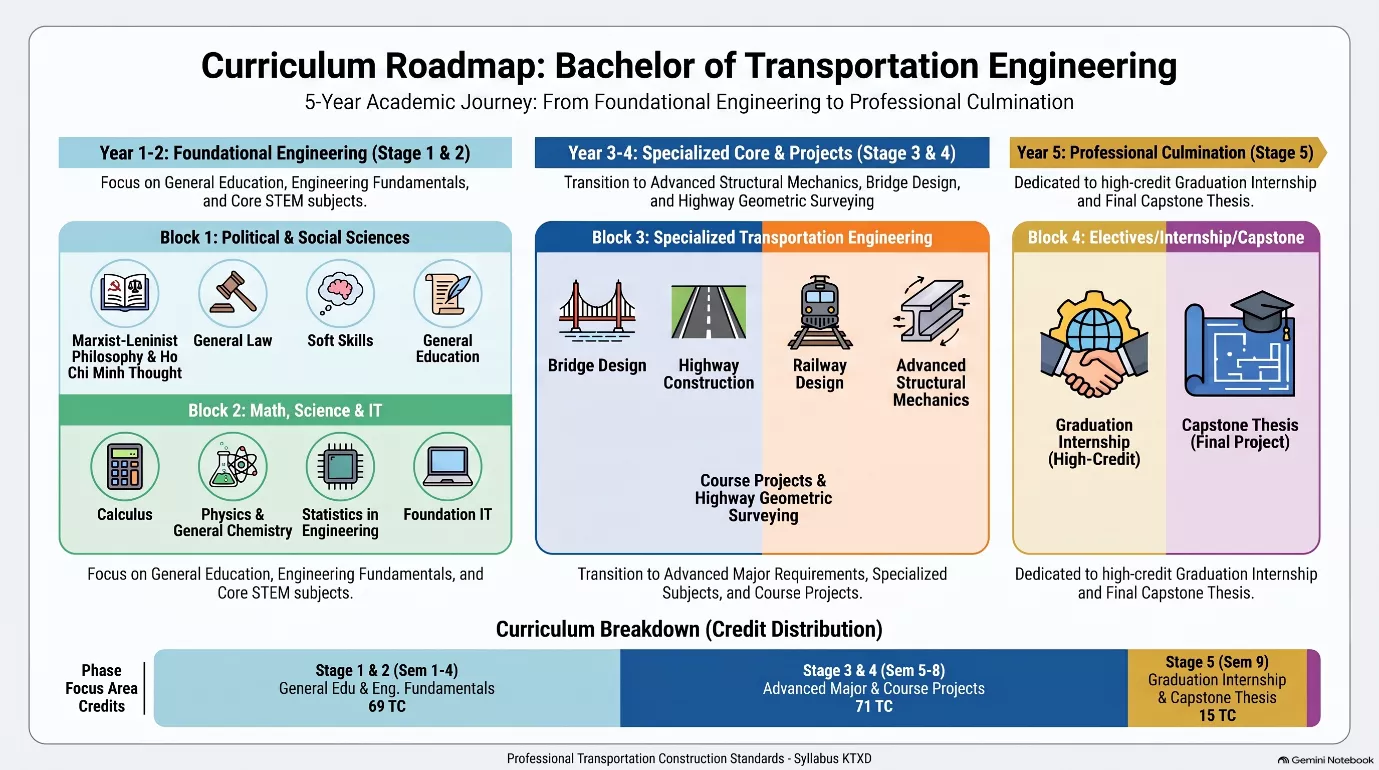
Detailed undergraduate curriculum roadmap supplied with the source.
MASTER’S PROGRAMME — TRANSPORTATION ENGINEERING
Introduction
This application-oriented programme develops advanced expertise in the design, construction, management, operation and maintenance of bridges, highways, railways, tunnels and urban transport systems. Advanced analysis is combined with digital technologies such as BIM, GIS and intelligent transportation systems.
Highlights
The programme links rigorous engineering methods with professional practice. Learners use contemporary numerical and geotechnical tools, engage with experienced faculty and industry partners, complete a professional internship, and undertake an applied master’s project addressing a real infrastructure challenge.
| Credits | 60 credits |
| Duration | 1.5–2 years |
| Orientation | Application-oriented |
Objectives
Graduates are prepared to analyse and solve complex transportation-engineering problems, select and use advanced software and digital workflows, conduct applied research, manage technical risk and project implementation, and communicate effectively in professional and international settings.
Career Prospects
Graduates may progress to senior technical, consulting, project-management and operational roles in public agencies, project management units, design consultancies, contractors and infrastructure operators. The degree also supports careers in research and teaching and provides preparation for doctoral study.
Programme Structure
| Knowledge block | Credits | Share |
| General knowledge | 9 | 15.0% |
| Core and specialised knowledge | 38 | 63.3% |
| Professional internship and master’s project | 13 | 21.7% |
| Total | 60 | 100% |
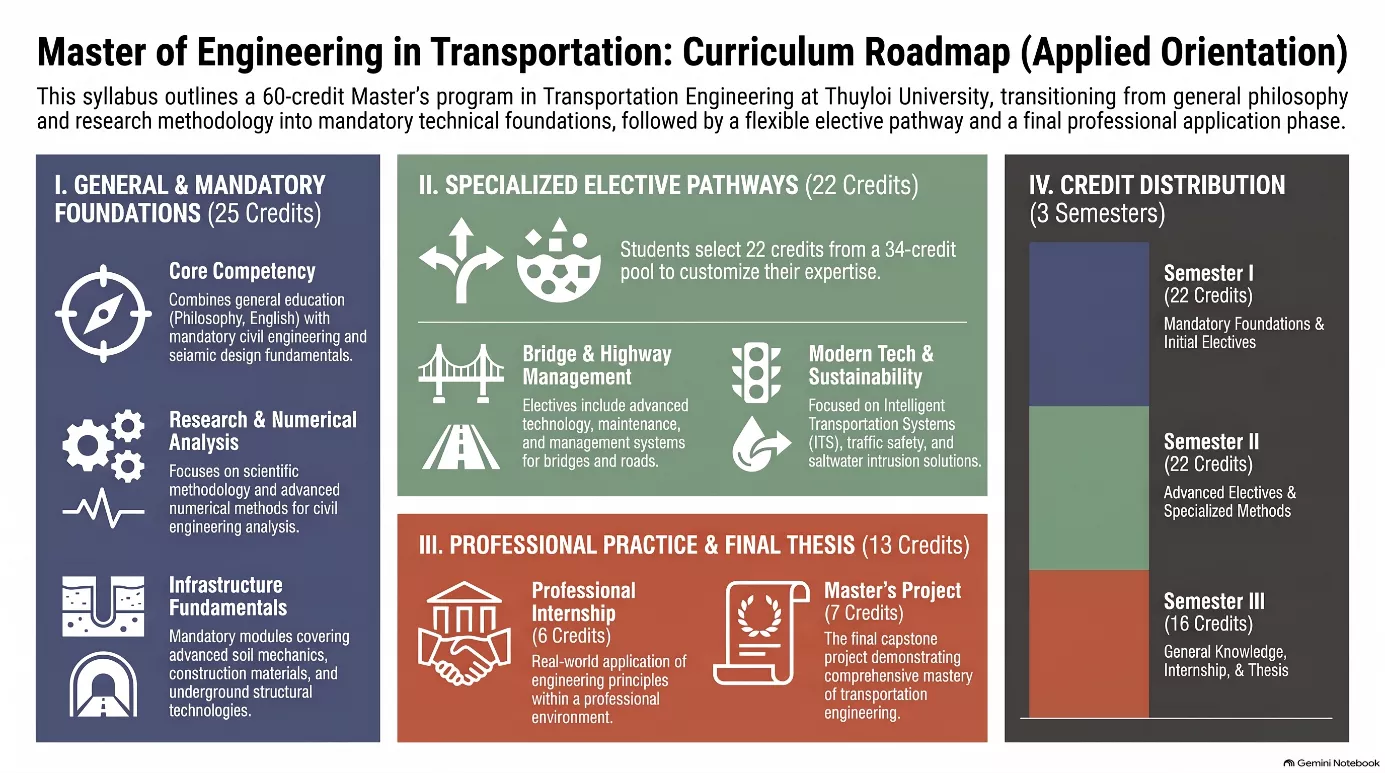
Master’s programme curriculum roadmap supplied with the source.
Academic Staff
The source reports four associate professors, one doctoral-level lecturer and one master’s-level lecturer. Individual names are not listed in the programme description.
Contact
- Department of Transportation Engineering, Faculty of Civil Engineering.
- Room 422, A1 Building, 175 Tay Son Street, Kim Lien Ward, Hanoi.
- Head: Assoc. Prof. Dr. Ngô Trí Thường — [email protected]
- Deputy Head: Assoc. Prof. Dr. Lương Minh Chính — [email protected]